




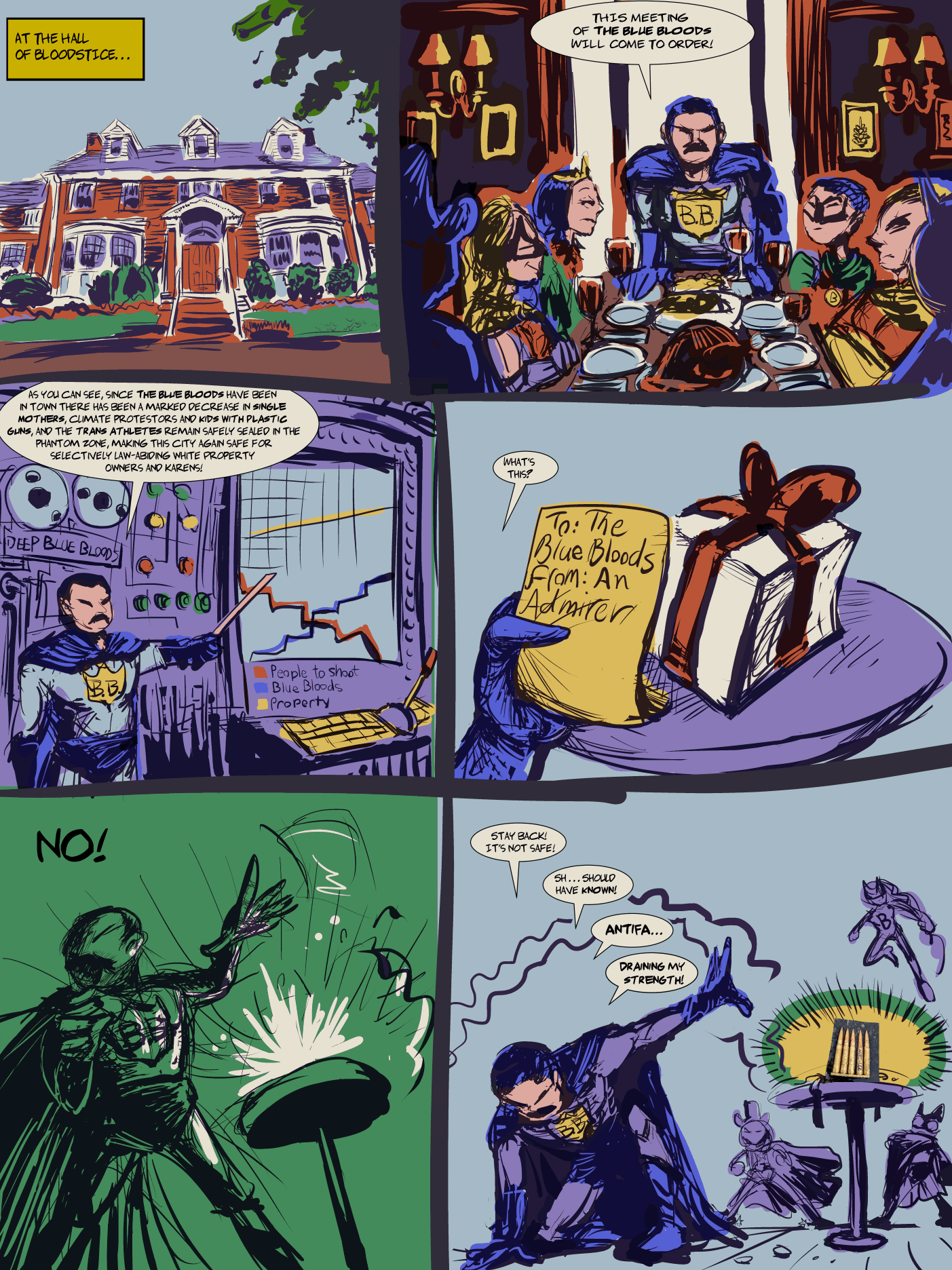
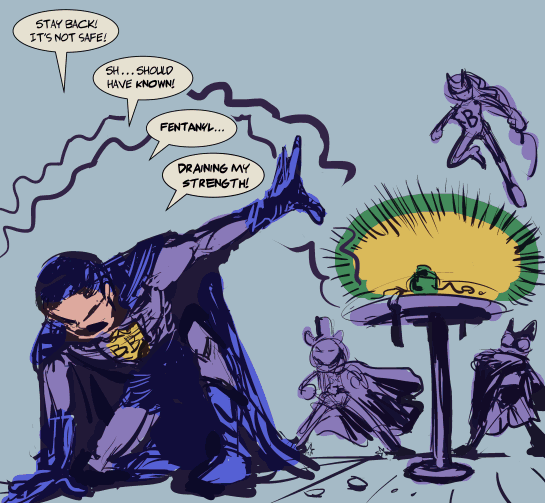
i was indecisive about the final frame since it took me two years to bother finishing the sketch since I can’t draw like this very well, and it seemed like the police state object of exaggerated bogeyness is now bullets of dubious origin with mysterious writing of dubious authenticity. ALTHOUGH maybe you can’t actually tell that is what this is here since I made the edit so hackily.
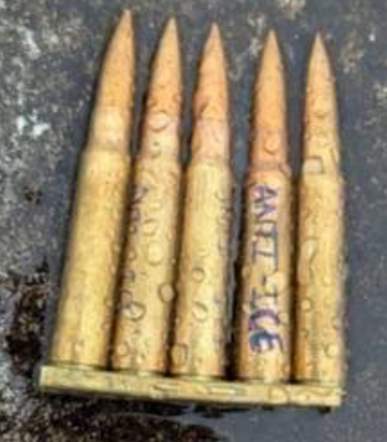
However the issue is mostly mootly since Blue Bloods was apparently cancelled in 2024 and most people i have access to have never heard of blue bloods to begin with, since they didn’t have sickly/elderly parents who just watch basic cable reruns of syndicated garbage all day in the mid 2010s and people who ARE that or share its mindset aren’t watching my art pages, at least not at this point, except for the purposes of trying to determine my own weaknesses and intermittently sending what they consider examples of it at me. However my real weakness is that i talk about my weaknesses too much. Nobody would know if I didn’t tell, and I get nothing out of telling, yet i continue to do so.
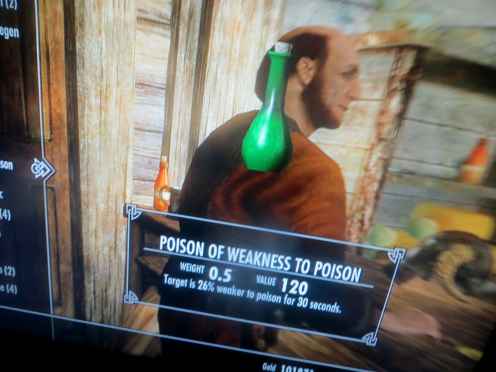
the fellow in the distance, presumably his weakness is hats
RSS feed for comments, for they hunger.
This here`s me trackback!
??? sez:
????????????
Frimpinheap sez:
Indeed, that is how i feel whenever you show up, also.
Anonymous sez:
More victim blaming from the right huh? Is it so wrong to be “anti” an organization that deliberately seeks to ruin the lives of random immigrants out of closeted racism and xenophobia? Well, the racism part is closeted, at least.
Frimpinheap sez:
when you convince yourself that vaccines cause autism, earth’s non-flatness is a hoax and that slavery was GOOD for the enslaved parties, believing all immigrants and also non-immigrants who happen to be in the vicinity are violent criminals finally getting their due regardless of how peacefully they get assaulted by armed, masked barbarians is probably pretty easy.
Don Hallings sez:
Ignore the other comments
The comic Bloodfeud uses the Batman mythos to deliver a biting political satire that explores wealth, privilege, and ideological conflict in Gotham City. Through exaggerated caricature and sharp irony, the story turns the familiar imagery of superhero justice on its head, using the “Blue Bloods” as a parody of elite power structures masquerading as moral authority. In doing so, it becomes both a lampoon of reactionary politics and a commentary on the way superhero narratives can be co-opted to serve class interests.
The opening panels set the tone perfectly. The “Hall of Bloodstice,” an absurdly aristocratic twist on “justice,” instantly signals the story’s focus on class and hypocrisy. The Blue Bloods—a group of costumed elites meeting over fine wine to discuss law and order—represent the consolidation of power among those who claim to protect society while truly defending their own privilege. The satirical language (“making this city safe for selective law-abiding white property owners and currency”) lands with precision, mocking the rhetoric of “order” that often masks exclusionary policies in real-world politics.
The comic’s greatest strength lies in its fearless use of visual and verbal irony. The Blue Bloods’ self-congratulatory speeches unfold beside images of control panels labeled “People to Shoot,” “Blue Bloods,” and “Property,” exposing their hypocrisy without ever needing overt exposition. The sudden arrival of a mysterious gift—revealed to be a trap from “Antifa”—shifts the story from satire to dark political allegory, dramatizing how entrenched power views grassroots resistance as an existential threat. The exaggerated reactions (“Antifa… draining my strength!”) lampoon the victim complex of those who frame social activism as persecution.
Yet beyond its humor, Bloodfeud engages seriously with the politicization of heroism. The parody works because Batman’s mythology has long been entangled with ideas of justice, authority, and vigilantism. By depicting a distorted mirror version of Batman—a “Blue Blood” whose crusade is explicitly classist—the comic invites readers to reconsider the ideological foundations of superhero narratives. Who does Batman protect? Who defines crime? And whose version of justice prevails?
However, while the comic succeeds as satire, its political commentary could benefit from greater narrative subtlety. The dialogue and imagery, though effective, sometimes state their points too directly, leaving little room for reader interpretation. A few more layers of ambiguity—perhaps showing how some Blue Bloods genuinely believe they are doing good, or allowing the “Antifa” figure more symbolic complexity—could make the story’s critique richer and more unsettling. Similarly, expanding on the aftermath of the explosion or the public’s reaction could ground the satire in broader societal consequences, emphasizing how elite panic ripples through the city.
Artistically, the rough, expressionistic style works to the comic’s advantage. The exaggerated colors and distorted figures echo underground political comics of the 1970s and 1980s, underscoring the story’s irreverent tone. The loose linework mirrors the moral chaos within the narrative—there are no clean heroes or villains, only ideologies in collision. Still, a bit more visual clarity in some panels (especially during the explosive sequence) could enhance pacing and readability without sacrificing style.
In sum, Bloodfeud is a bold and darkly humorous addition to the Batman-inspired tradition of political storytelling. It turns the trappings of superhero myth into a mirror for class anxiety, moral hypocrisy, and the fear of resistance. Its satire is sharp, its art raw and deliberate, and its political message unmistakable. If future installments deepen its moral ambiguity and expand the perspectives involved, Bloodfeud could evolve from a clever parody into a fully realized political epic—one that reminds readers that the line between heroism and hegemony is far thinner than Gotham’s elites would like to admit.
Frimpinheap sez:
shame on you, punishing that poor blowhard robot with this.